Killeen Elite Concrete works as a concrete contractor in Belton, TX, and there is one rule here that decides more about a residential job than the concrete does. In the city’s historic districts, repaving front yard paving, concrete work and walkways counts as ordinary maintenance only where material the same or similar in appearance is used.
That single qualifier is the difference between a straightforward replacement and a job that has to go through the Historic Preservation Commission first. Repairing or repaving flat concrete work in side and rear yards is exempt outright. Out front, a like-for-like gray replacement is ordinary maintenance, and a change of finish or material is not.
We raise it at the quote rather than after a homeowner has fallen in love with a stamped pattern, because on a historically zoned property the finish is a permissions question before it is an aesthetic one. Outside those districts none of it applies, and we will tell you plainly which side of the line your address sits on.
Five Historic Districts and the Material Rule
Where the Rule Applies
The City Council has approved a Historic Preservation Ordinance and designated five historic districts: South Main, Lower West Belton, Downtown Commercial, Central Belton and North Central Belton. The Historic Preservation Commission meets at 5:30 p.m. on the first Thursday of each month, and some approvals are granted administratively by the Historic Preservation Officer.
The Downtown Commercial district covers eight blocks centered on the County Courthouse Square, with 46 contributing and 21 noncontributing buildings, and was listed on the National Register on December 26, 1990. Knowing whether a property is inside one of those five boundaries is the first thing to establish on any job with a visible frontage.
Side and Rear Yards Are Exempt Outright
The Design Standards define ordinary maintenance and repair as work that does not result in a change in the existing appearance and materials of a property, and they include repairing or repaving of flat concrete work in side and rear yards in that definition without qualification.
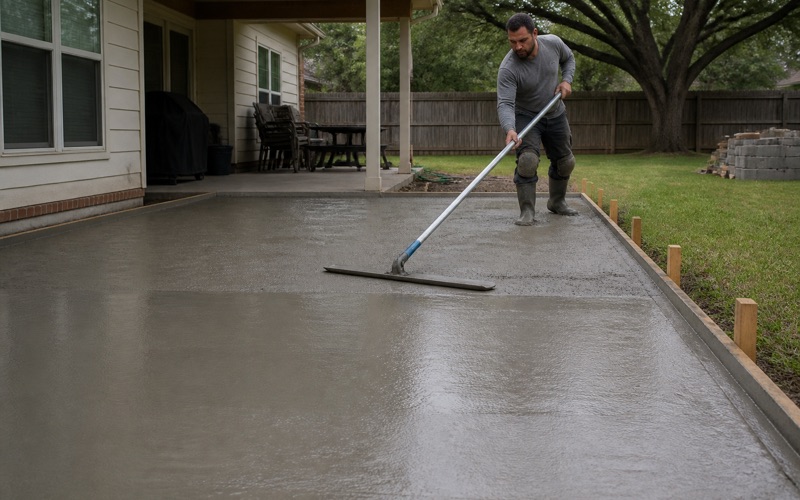
That covers a great deal of practical work: back patios, side walks, utility pads, slabs behind a fence line. It is worth knowing before assuming a historically zoned address means every pour becomes a permissions exercise, because most of the flatwork on a residential lot is not out front.
Out Front, Same or Similar Material
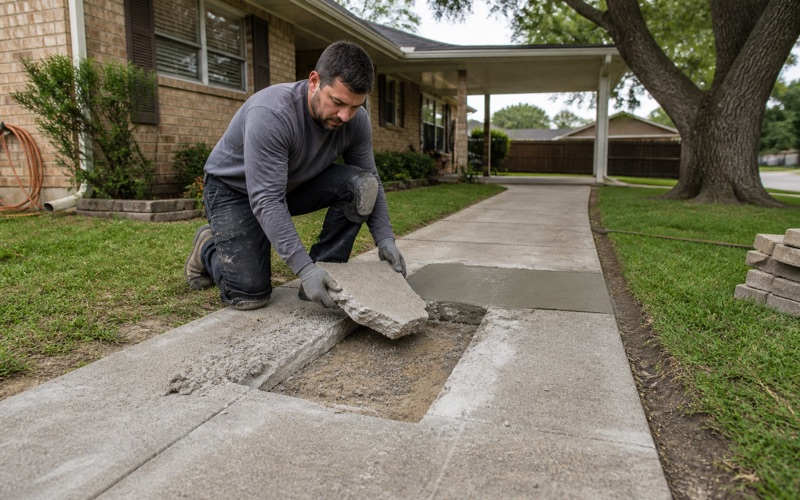
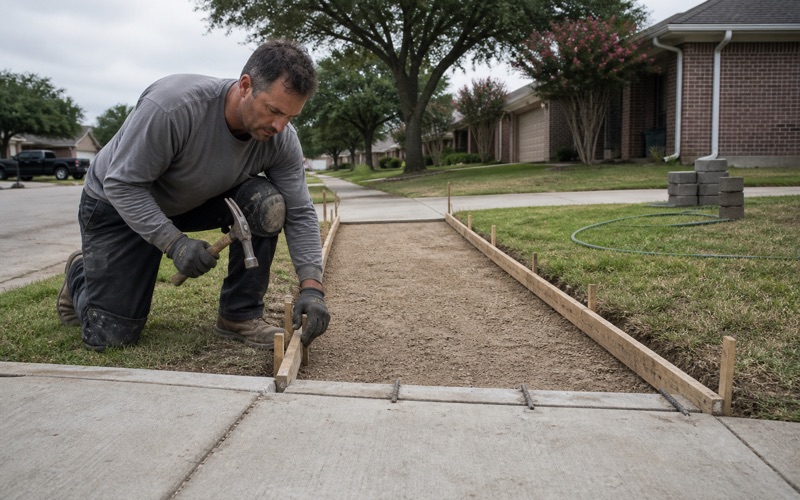
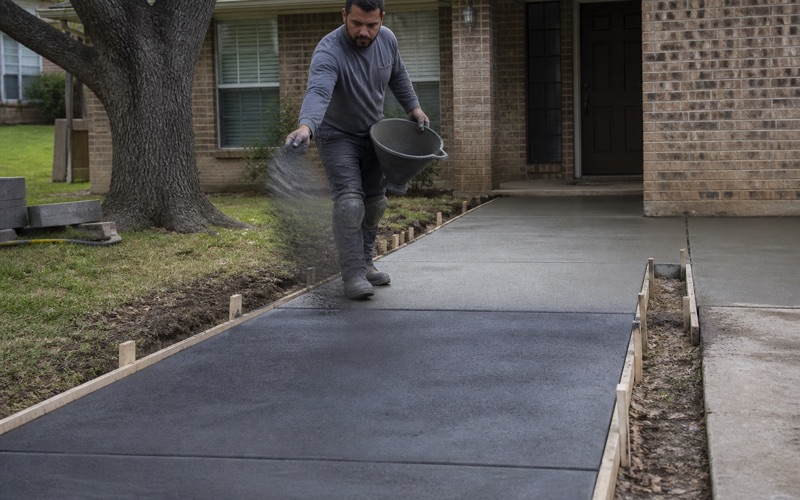
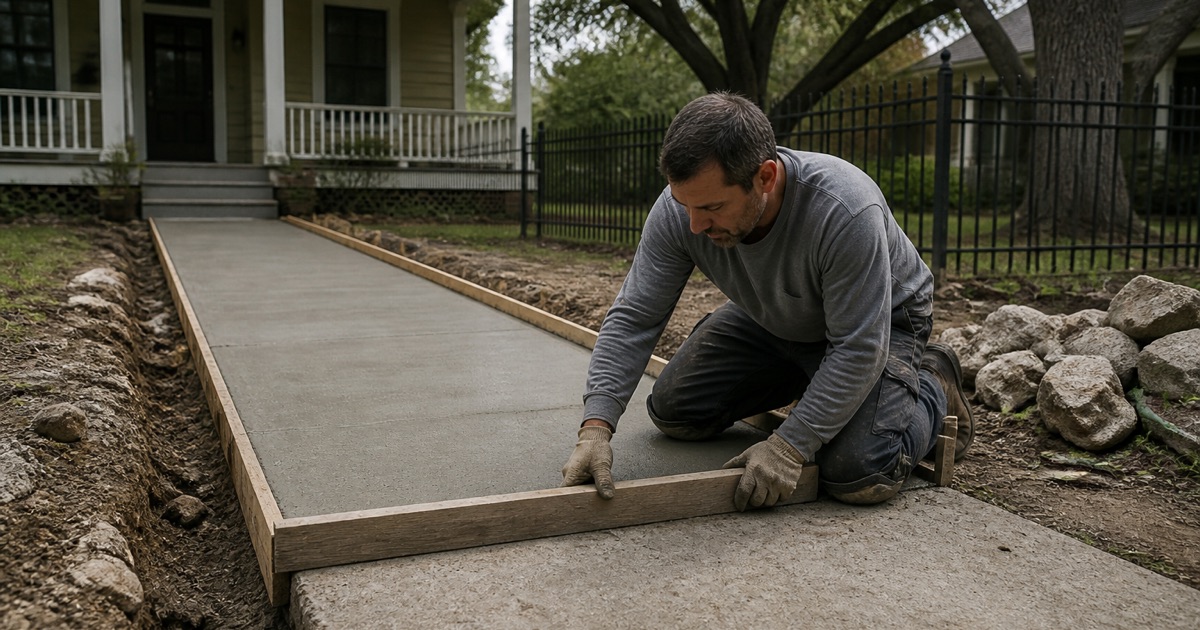
For existing front yard paving, concrete work and walkways, the same standards include repairing or repaving in ordinary maintenance only if material the same or similar in appearance is used. Replacing a cracked gray broom-finished walk with a new gray broom-finished walk is maintenance.
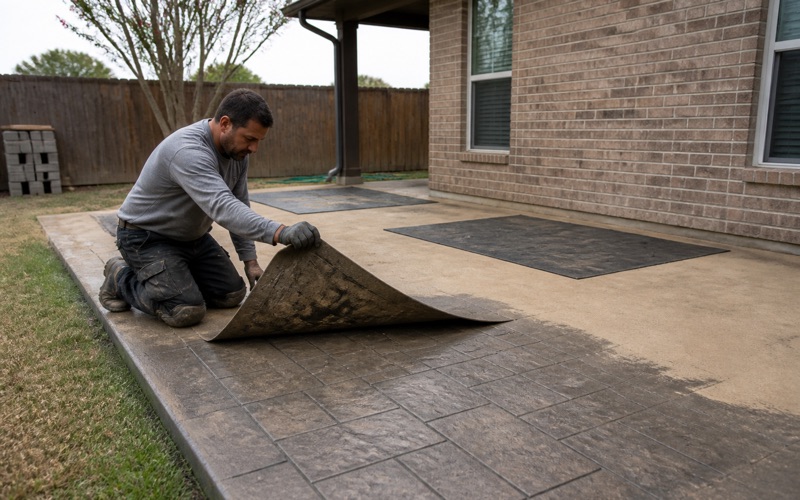
Replacing it with an exposed aggregate finish, a stamped pattern or an integrally colored slab is a change in appearance and materials, and it is a review question rather than a contractor’s choice. We are happy to do either, and the sequence matters: settle the permissions before ordering the mats.
Looking for concrete contractor closer to Jarrell? See Jarrell Concrete Contractor.
Crawford Clay That Bottoms Out on Rock
The Most Extensive Soil in the City
Belton sits where the Blackland Prairie meets the Edwards Plateau, and its mapped soils carry both signatures. Crawford silty clay is the most extensive mapped soil inside the city limits at roughly 17 percent of mapped soil area: a Leptic Udic Haplustert with 45 to 50 percent clay and a plasticity index of 33 to 38.
The important word in that classification is leptic. Linear extensibility runs 10 to 17 percent, so it is genuinely reactive ground, but it sits on lithic limestone bedrock at 28 to 36 inches. It moves like a strong clay while being only two to three feet deep, which is a different footing problem from a deep profile.
Around Forty Percent of the City Is Shallow to Limestone
Purves, Eckrant, Speck, Real and Brackett together account for roughly 43 percent of the mapped soil area inside the city limits, and SSURGO maps lithic or paralithic bedrock between 9 and 19 inches of the surface across them. Pier drilling and deep trenching in those units reach rock rather than clay.
Purves sits on indurated lithic bedrock at about 14 inches and Eckrant between 9 and 15 inches. The dominant clays here all clear the plasticity index of 15 that IRC R403.1.8.1 uses as its first expansive-soil criterion, with Real the exception at 12 to 20 on 30 to 31 percent clay.
The Creek and River Bottoms Behave Differently
The Nolan Creek and river bottoms inside the city are mapped as Bosque clay loam and Frio silty clay, both flooded units. Bosque carries a plasticity index of 16 with linear extensibility of only 1.5 percent, so bottomland flatwork sits on materially less reactive ground than anything on the uplands.
Frio runs higher at 44 percent clay and a plasticity index of 34 to 36. Both are flood-mapped, and the city charges a 50 dollar Floodplain Assessment Permit under Ordinance #2016-34, so a slab down in the bottoms carries an extra approval that the same slab three streets uphill does not.
Permits Run Through Public Works, Not the Building Official
A Named Driveway and Flatwork Permit
Belton issues a Driveway and Flatwork Permit with inspection at 75 dollars plus 25 dollars per additional approach, under Ordinance #2025-57 on a fee schedule effective January 1, 2026. Sidewalks, patio covers, decks and porches fall under the 60 dollar basic building permit fee instead.
Working without a building permit is charged at twice the permit fee, which makes pulling it the cheapest decision available. We handle the application as part of the job rather than leaving a homeowner to work out which of the two fee lines their project sits on.
Who Actually Issues It
Driveways, curbing and sidewalks are Public Works permits routed to the Director of Public Works rather than to the Building Official, which is not how most cities in this area are organized. Sending a driveway application to the building counter is a straightforward way to lose a week.
Right-of-way work runs on a separate City Public Rights-of-Way Construction Permit under Ordinance No. 2016-30, which asks the applicant to state backfill material and depth, including flowable fill, and quantities for concrete driveway, curb and gutter, and concrete pavement replacement including depth.
Contractor Registration Is Annual and Includes Us
The city requires contractor registration at 50 dollars per calendar year, excluding state-licensed electrical and plumbing contractors in accordance with state law. A concrete contractor is not among the excluded trades, so registration is a live requirement rather than a formality somebody else handles.
Because Texas issues no state license for concrete work at all, that city registration is effectively the whole of the paperwork credential in this trade. We keep it current, and we would rather you asked to see it than assumed.
The Published Standard and Accessible Routes
Class A Concrete and the Detailing That Goes With It
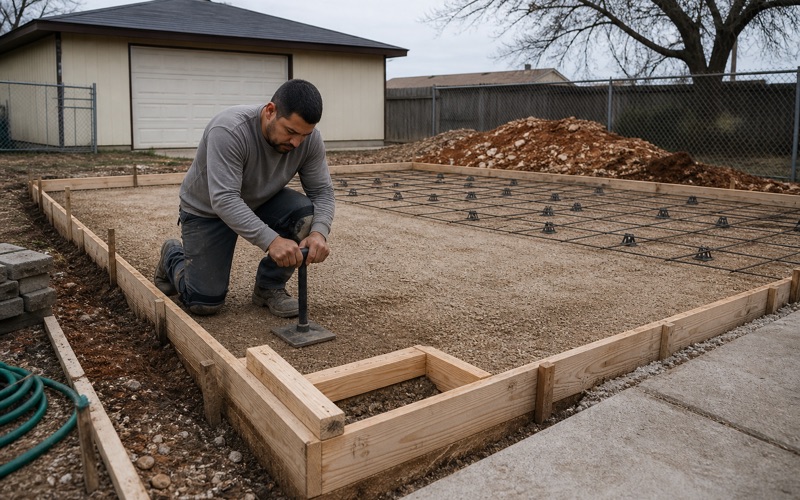
The Public Works Design Manual, adopted under Section 20-79 and applying in the city and its extraterritorial jurisdiction, requires all concrete to have a minimum 28-day compressive strength of 3,000 psi unless otherwise noted, with slump per TxDOT Item 420 and reinforcement to ASTM A615 Grade 60.
The standard details go further: Class A 3,000 psi concrete, one-half inch expansion joint material where curb is adjacent to sidewalk, drive approaches, rip-rap and radii, white pigmented curing compound applied per TxDOT Item 420, and dowels epoxied in where doweling into existing concrete. Those are specified details rather than preferences.
Curb Ramps and the Fifty Thousand Dollar Threshold
Belton’s standards call the accessible feature a curb ramp and cite the Texas Accessibility Standards. Ramps are required at each intersection of a sidewalk and a street, must comply with TDLR and ADA requirements, and sidewalks are to be doweled into existing curbing or inlets.
Plans including pedestrian facilities are submitted to the Texas Department of Licensing and Regulation, and a TDLR inspection is required where estimated construction cost is 50,000 dollars or more, at the developer’s expense. That threshold is worth checking against a project budget before the program is set rather than after.
The Redevelopment Threshold That Generates Frontage Work
Under the City Design Standards, any new development site or redevelopment in excess of 25,000 dollars requires concrete driveway approach aprons placed adjacent to the property line in the right-of-way, and a concrete sidewalk continuing the entire length of the property.
That is a low threshold and it catches a lot of commercial refurbishment, turning an interior project into a frontage project. A fee in lieu is available under Section 503 of the Subdivision Ordinance at 120 dollars per square yard, so the choice is between building the walk and paying for it.
A County Seat, and What That Changes
County Authority for Everything Outside a City
Belton is the seat of Bell County, so the county-level chain for work outside any city sits here. The County Engineer reviews plats, construction plans and drainage calculations for unincorporated land and for the extraterritorial jurisdiction of the major cities, and Commissioners Court approves the plat.
The Bell County Public Health District certifies plats where sanitary sewer is not available, and resulting lots need a minimum of 50 feet of frontage on a dedicated public road. Bell County does not run a countywide building code for unincorporated construction, which surprises people expecting one.
Code Editions Change on October 1, 2026
As of August 2026 the city is still enforcing the 2015 ICC I-Codes. The city has announced that the 2024 ICC codes take effect on October 1, 2026, following a public meeting held on April 30, 2026 at the Harris Community Center and developed jointly with the City of Temple and the Temple Area Builders Association.
A project straddling that date is worth scoping against both editions rather than one, particularly where a plan review will land close to the changeover. We track it because a submittal reviewed under the wrong edition is a resubmittal, and the difference is a few weeks nobody budgeted.
The Built Fabric the Rules Are Protecting
The three-story Bell County Courthouse was built in 1876 to the design of J. N. Preston and was listed on the National Register in 1976, and it anchors the downtown square the commercial district is drawn around. The University of Mary Hardin-Baylor, founded in 1845, has grown its campus here from an original 10 acres to more than 340.
That is the context the material rule exists to protect, and it is why we treat it as a design constraint rather than red tape. A front walk in one of these districts is part of a streetscape somebody has taken the trouble to designate, and matching it is usually the better-looking answer anyway.
- 20+ Years in Central Texas
- Registered and Insured in Killeen
- Free Written Estimates