
Killeen Elite Concrete pours concrete driveways in Killeen, TX and the surrounding cities including Fort Hood, Harker Heights, Nolanville, Copperas Cove and Belton, and we have been doing it here for more than 20 years. A driveway is the largest single piece of flatwork on most properties and the one that has to carry real load every day, so it is the one where the ground beneath it matters most and where a cheap quote costs the most later.
Two things separate a driveway that lasts thirty years from one that is cracking in five, and neither of them is the concrete itself. The first is the subgrade: what soil unit the lot sits on, how deep the limestone or caliche is, and whether the base was properly prepared and compacted before anything was formed. The second is the joint layout, because on ground that moves seasonally the joint pattern is what decides where the slab cracks.
The third thing is paperwork, and it catches people out because it is invisible until it is not. The driveway approach where it crosses into city right of way is the abutting owner’s to build and to pay for under section 25-91, and it carries its own permit, its own filed estimate and a performance bond. We handle that end as part of the job rather than leaving it as a surprise.
Before Anything Is Poured
Reading the Subgrade on Your Lot
We identify which soil unit the driveway will sit on before quoting, because inside these city limits the answer changes across a single subdivision. Eckrant soils hit limestone at roughly nine inches and Purves at about fourteen, while San Saba runs closer to thirty and Evant carries a cemented caliche hardpan at about nineteen. That depth to refusal is the number that sets your excavation cost, and guessing it is how a quote doubles mid-dig.
Excavation, Base and Compaction
Once the depth is known, the driveway is excavated to grade and a base is built and compacted rather than simply graded flat. Depending on the soil that may mean flexible base, a cement treated base or a lime treated subgrade to reduce the shrink swell potential underneath. Compaction is measured, not eyeballed, because a base that settles half an inch after the pour takes the slab with it.
Reinforcement and Section Thickness
Thickness and reinforcement come from what the driveway carries, not from a default. A standard car drive, a drive that has to take a fifth wheel, and one that a delivery truck will turn on are three different sections. We place welded wire reinforcement or rebar on chairs and slab bolsters so it sits in the upper part of the section where it actually resists tension, rather than lying on the ground doing nothing.
Pouring and Finishing a Driveway Here
Joint Layout Set Before the Truck Arrives
Control joints are laid out to published spacing of roughly 24 to 36 times the slab thickness and marked before the pour, not decided afterward. We cut them with an early entry dry cut saw while the concrete is still green, so the crack that is coming forms inside a line you cannot see. Expansion joints go in where the drive meets the garage, the approach and any curb or wall.
Placing Against the Discharge Clock
Once ambient temperatures pass 90 degrees the truck has 45 minutes from batch to placement, so summer pours are scheduled against that clock rather than around the rest of the day. Concrete worked past its window finishes badly at the surface, and surface problems on a driveway show up as dusting and scaling within a couple of years. Timing is a quality decision, not a logistics one.
Finish, Slope and Curing
A broom finish is the default on a driveway because it gives dependable grip when wet and hides normal wear well. Slope is set to move water off the slab and away from the house rather than toward it, since water sitting at an edge is what undermines a base. We then cure the slab deliberately with a curing compound instead of letting it dry out fast in the sun.
The Approach, the Right of Way and the Permits
Where Your Driveway Stops Being Yours
The approach between the street and your property line sits in city right of way, and section 25-91 withholds approval of building work until non-conforming abutting curbs, gutters and street curbs are brought to city standard under a separate permit. Section 25-37 puts that work at the applicant’s sole expense. Knowing where that line falls on your lot is part of quoting the job properly.
The Standard the Approach Is Built To
Killeen’s driveway approach standard is a state document. Section 25-81 adopts the plans and specifications of the Regulations for Access Driveways to State Highways, placed into effect by Texas Highway Commission Minute Order No. 45920 dated May 1, 1959, and applies them to all streets and to curbs and gutters on any public property in the city. Where a property fronts a state road, a state permit applies as well.
Permits, Bonds and Fees You Should Know About
Flatwork is permitted by area at 11 cents per square foot with a 70 dollar minimum, plus a 10 dollar technology and application fee, and the city doubles the fee where work starts before the permit issues. Right of way work needs an estimated cost filed with the city engineer and a performance bond equal to it, and any excavation deeper than 18 inches there carries a 2,000 dollar surety bond.
Replacing an Existing Driveway
Deciding Between Repair and Replacement
Not every tired driveway needs tearing out. Where the slab has dropped as a unit and the surface is sound, lifting it costs a fraction of replacement. Where it is broken into panels that no longer span, has lost its surface to scaling, or was poured too thin for what now parks on it, replacement is the honest answer and we will show you which one you have.
Demolition, Disposal and What Comes Back
Replacement means removing the old slab, reassessing the base that is revealed underneath, and correcting it before the new pour rather than pouring straight back onto the same problem. The IDDSM general provisions require driveways disturbed by construction to be replaced to the limits and thicknesses that existed before the work, which matters where the disturbance is somebody else’s.
Widening, Extensions and Parking Pads
Adding a parking pad, widening a drive for a second vehicle or extending it to a shop is common here and it is not simply more of the same slab. A new section poured against an old one needs a keyed construction joint or dowel baskets so the two move together, and the new base has to match. Butting new concrete against old without that detail cracks the joint open.
Our Step-by-Step Concrete Driveway Process
Site Visit, Soil Check and Measurement
We measure the drive, identify the soil unit and the likely depth to rock, look at drainage, and establish what the finished driveway actually has to carry. That last question matters more than most people expect, since a drive sized for two cars and one that has to hold a fifth wheel are different slabs entirely.
Written Quote With the Approach Included
You get one written price covering excavation, base, reinforcement, the pour, the finish and the right of way portion with its permit and bond, rather than a headline number that grows later. Where rock is likely, the quote says how that is handled before the dig instead of after it.
Permits Pulled Before Work Starts
We file the flatwork permit and the right of way application with its estimated cost, because the city doubles the fee where work begins before a permit is issued. The performance bond for the approach is arranged at the same time, so that portion is not left waiting on paperwork once the drive itself is ready.
Excavate, Form, Reinforce and Pour
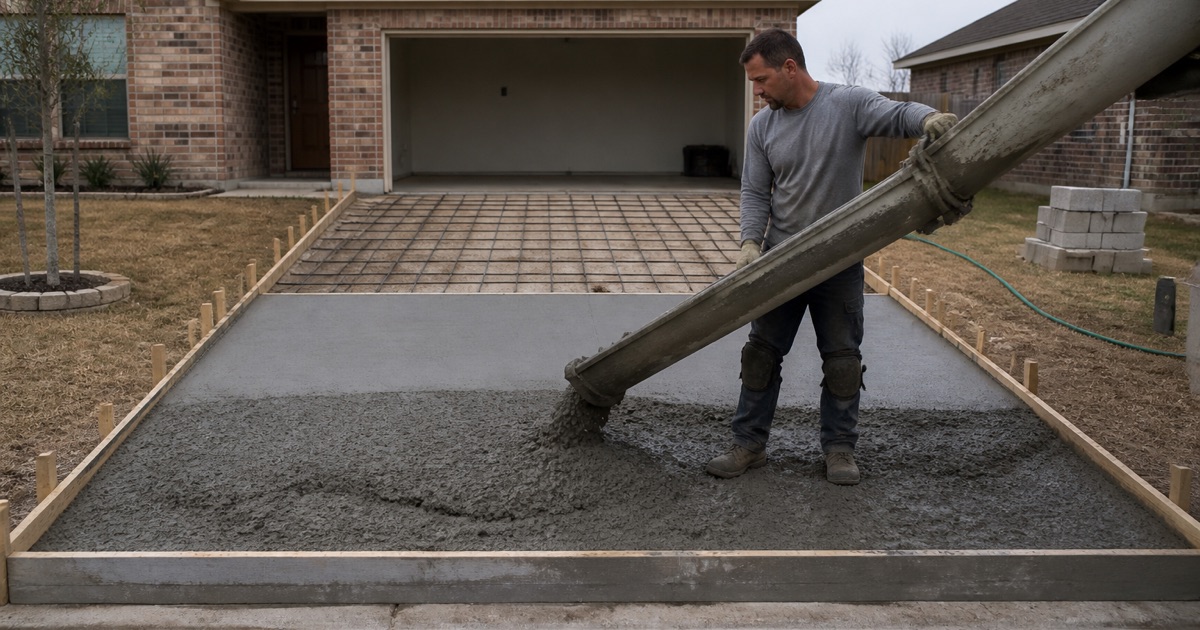
The drive is cut out, the base built and compacted, forms and reinforcement set, joints marked, and the concrete placed inside its discharge window and finished to the agreed texture. Reinforcement goes on chairs and bolsters so it sits where it carries tension rather than lying flat on the base.
Cut, Cure and Hand Over
Control joints are sawcut early with a dry cut saw, the slab is cured deliberately rather than left to dry out, and we give you the date it takes vehicle load instead of leaving you to guess. We then walk the finished drive and the approach with you against the written scope before anything is invoiced.
- 20+ Years in Central Texas
- Registered and Insured in Killeen
- Free Written Estimates