
Killeen Elite Concrete does concrete leveling in Killeen, TX and the surrounding cities including Fort Hood, Harker Heights, Nolanville, Copperas Cove and Belton, and after twenty years on these soils we will quote both lifting methods and replacement side by side rather than steering you to the one we own the gear for. A slab that has dropped an inch is rarely a slab that has failed, and knowing the difference is most of the value here.
Leveling raises a settled slab back to its original elevation by filling the space that opened beneath it. It is a fraction of the cost of tear-out, it takes hours instead of days, and the surface takes traffic almost immediately. What it cannot do is make a broken slab whole, restore a surface that has scaled away, or stop soil from moving again if nothing about the drainage changes.
The settlement itself has a local cause. Clay with a plasticity index in the high thirties shrinks back as it dries and leaves a void; fill placed over a utility trench consolidates unevenly; and where limestone sits nine to fourteen inches down under one part of a slab and thirty under another, the two halves were never going to settle at the same rate. We work out which of those you have before we drill a hole.
Why Slabs Settle in This Part of Central Texas
Clay Shrinkage and the Void It Leaves
Expansive clay loses volume as it dries out through a long summer, and the slab bridging it does not follow the soil down evenly. The result is a panel supported at its edges with nothing under the middle, or supported on one side only. Linear extensibility around 6.8 percent for Purves and 12 for Denton is enough movement to open that gap over a single season.
Fill, Trench Lines and Made Ground
Driveways and patios poured over backfilled utility trenches, over the fill placed to level a sloping lot, or over an old excavation settle where that fill consolidates. It shows up as a straight-line drop that follows the trench rather than the random pattern soil movement produces. Recognizing the shape of the settlement usually tells us the cause before anything is probed.
Water Moving Under the Edge
Roof water discharging beside a slab, a grade that falls toward the concrete rather than away, or an irrigation leak will wash fines out of the base and drop a slab far faster than clay shrinkage does. This one repeats if it is not corrected. We look at where water goes before agreeing to lift anything, because otherwise the same panel drops again.
Polyurethane Foam Injection
How the Foam Lift Works
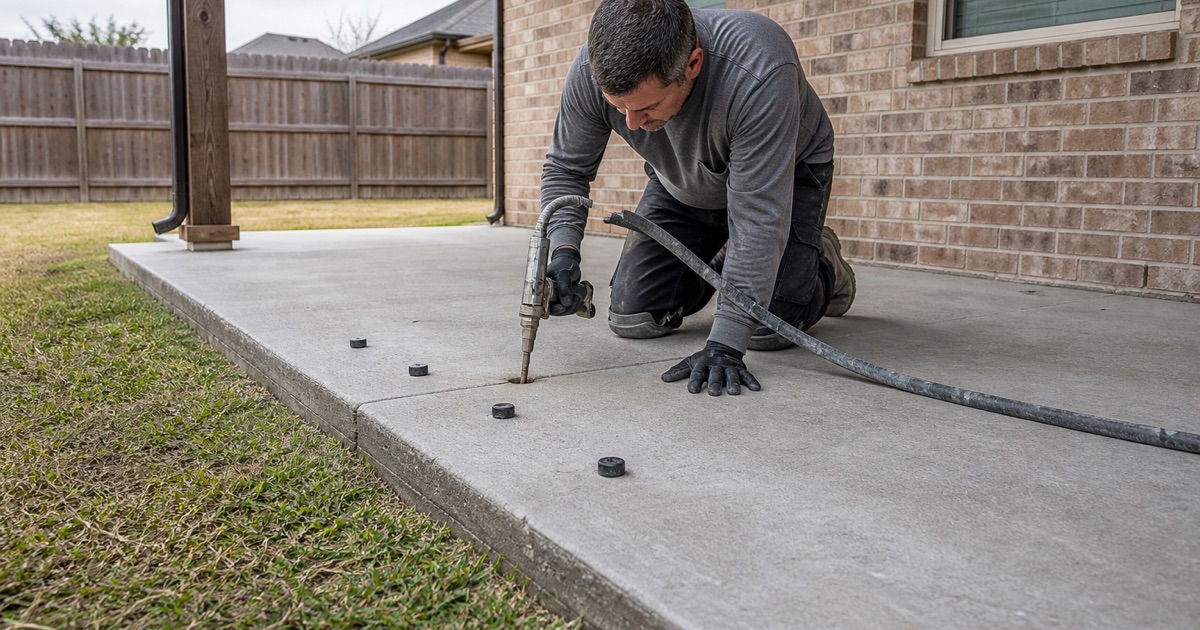
Small ports are drilled through the slab, usually around five eighths of an inch, and a two-part polyurethane is injected beneath it. The material expands, fills the void and raises the panel under controlled pressure while we watch the elevation. Because the holes are small, the patched ports are far less visible afterward than the ones a slurry lift needs.
Weight, Cure Time and Traffic
Cured foam is light, which matters when the soil beneath already proved it could not hold what was on it. It reaches working strength within minutes, so a driveway lifted in the morning takes a car the same afternoon. That combination is why foam is usually the right call on residential drives, garage slabs and walkways where downtime is the real cost.
Where Foam Earns Its Premium
Foam costs more per square foot than slurry and is worth it where access is tight, where the finished surface matters, or where the slab sits over soil that cannot take additional load. Under a stamped or stained patio the small port size is the deciding factor. We will tell you when a job does not need it.
Mudjacking and Slurry Slabjacking
The Slurry Method
Mudjacking pumps a cementitious slurry through larger holes to fill the void and jack the slab back up. It is the older method and it remains a sound one on the right job. The material is inexpensive by volume, which makes it economical where a large area needs a modest lift and the surface is a utility finish rather than a feature.
Cost Against Consequences
Slurry is heavier than foam, so it adds load to the same soil that settled, and it needs larger patched holes and longer before full traffic. On a wide plain driveway or a warehouse apron none of that matters much. On a decorative slab or over soft made ground it matters a great deal, which is the honest trade-off we lay out.
Choosing Between the Two
We do not have a house method. The choice comes down to what is under the slab, how much load it can take back, how visible the ports will be, and how quickly the area has to return to service. You get both numbers and the reasoning, and if the cheaper one is right for your slab we will say so plainly.
Where Leveling Works, and Where It Does Not
Good Candidates for a Lift
A slab that has dropped as a unit, has cracks without significant vertical offset, and still has a sound surface is exactly what leveling is for. Sunken driveway aprons, settled walkways, patio panels that pond water, garage slabs and sidewalk sections all lift well. So do interior slabs where a floor has gone out of level in one area.
When Replacement Is the Honest Answer
Once a panel is broken into more pieces than it can span, the surface has scaled or spalled away, or the base is still actively washing out, raising it is money spent on a season. Structural foundation slab repair is a different job again, needing a permit here since Ordinance No. 22-004 and, since January 1, 2026, engineered documents.
Commercial and Multi-Unit Work
Warehouse floors, loading dock aprons, parking bays and apartment walkways all benefit from leveling precisely because the alternative closes the area for days. On rental property around Fort Hood a lifted walk can be safe and presentable between tenants inside one visit. Where a public sidewalk is involved, the finished elevation still has to satisfy accessibility requirements.
Our Step-by-Step Concrete Leveling Process
Elevation Survey and Void Check
We shoot elevations across the panels, sound the slab for hollow areas, and establish how far it has dropped and over what footprint before proposing anything at all. Knowing the size and shape of the void is what decides how much material a lift will take, and that is exactly the number a vague quote hides.
Cause Correction First
Drainage, downspouts and grade get addressed within the scope wherever they caused the settlement, because lifting a slab over a live washout is temporary by design. Where the cause sits outside concrete work altogether, such as a leaking service line, we tell you before the lift rather than after it drops again.
Injection and Controlled Lift
Ports are drilled, material is injected in stages, and elevation is monitored continuously so the slab comes up level rather than being over-lifted and cracked in the process. The lift happens in small increments across several ports instead of one push at a single point, which is what keeps a panel intact on the way up.
Port Patching, Joint Sealing and Handover
Holes are patched, open joints are cleaned and resealed to keep water back out of the base, and we tell you exactly when the area takes full load again. Resealing those joints is part of the job rather than an upsell, because water finding its way under the slab is usually what caused the settlement to begin with.
- 20+ Years in Central Texas
- Registered and Insured in Killeen
- Free Written Estimates