Killeen Elite Concrete works as a concrete contractor in Fort Hood, TX, and after more than 20 years of flatwork in Central Texas we can tell you the first thing that changes here: almost none of the permitting you would go through a few miles away applies at all. This is federal land under the Department of the Army, and the approval path is entirely its own.
That is not a technicality. There is no municipal building department with jurisdiction on the installation, no city construction registration to hold for work performed here, and no city inspector who will come out to look at a pour. The City of Killeen’s registration requirement reaches only construction operations performed within its own city limits, and the post sits outside every surrounding city’s boundary.
What replaces all of it is a permit most homeowners have never heard of, a building code administered by the Department of Defense rather than by a council, and a subgrade moisture specification that runs in the opposite direction from what a residential contractor is used to. We work to all three, and we would rather walk through them before a quote than after a stop-work order.
Concrete Work Under Federal Jurisdiction
No City Permit, Registration or Inspection Applies
Every part of the municipal process you would expect is simply absent on the installation. There is no flatwork permit priced by the square foot, no city technology and application fee and no failed-inspection charge, because no municipal building department has jurisdiction here in the first place.
What that does not mean is that the work is unregulated. The requirements are federal rather than municipal and in several respects they are tighter, not looser. A contractor who reads the absence of a city permit as an absence of process is a contractor who gets stopped on their first morning on site.
The Governing Code Is a Defense Department Document
Construction here is governed by UFC 1-200-01, the DoD Building Code, dated 1 September 2022 with Change 4 of 17 December 2024. Its paragraph 1-6.1 directs the use of the 2024 International Building Code and the 2024 International Existing Building Code, and that is the reference the work is measured against.
Under paragraph 1-5.2 the building official and authority having jurisdiction is the DoD design and construction agent responsible for the project, not a municipal inspector. Identifying which agent that is on a given job is part of scoping it, because the approval route follows the agent rather than the street address.
The Post Name, and Why It Matters on Paper
Naming is a live hazard in written work here, and getting it wrong on a submittal is an entirely avoidable delay. The installation was officially renamed on 9 May 2023 and then redesignated Fort Hood effective 11 June 2025, with the colors ceremony held on 28 July 2025.
The garrison’s own site is currently branded U.S. Army Fort Hood, home of the III Armored Corps, which confirms the live name. Hood Army Airfield separately became Yoakum-DeFrenn Army Heliport on 4 May 2023, so older drawings and site plans routinely carry names that no longer match anything current.
Looking for concrete contractor closer to Harker Heights? See Concrete Contractor Services in Harker Heights.
The Dig Permit, and the Queue Behind It
FH Form 200-10 Covers More Than People Expect
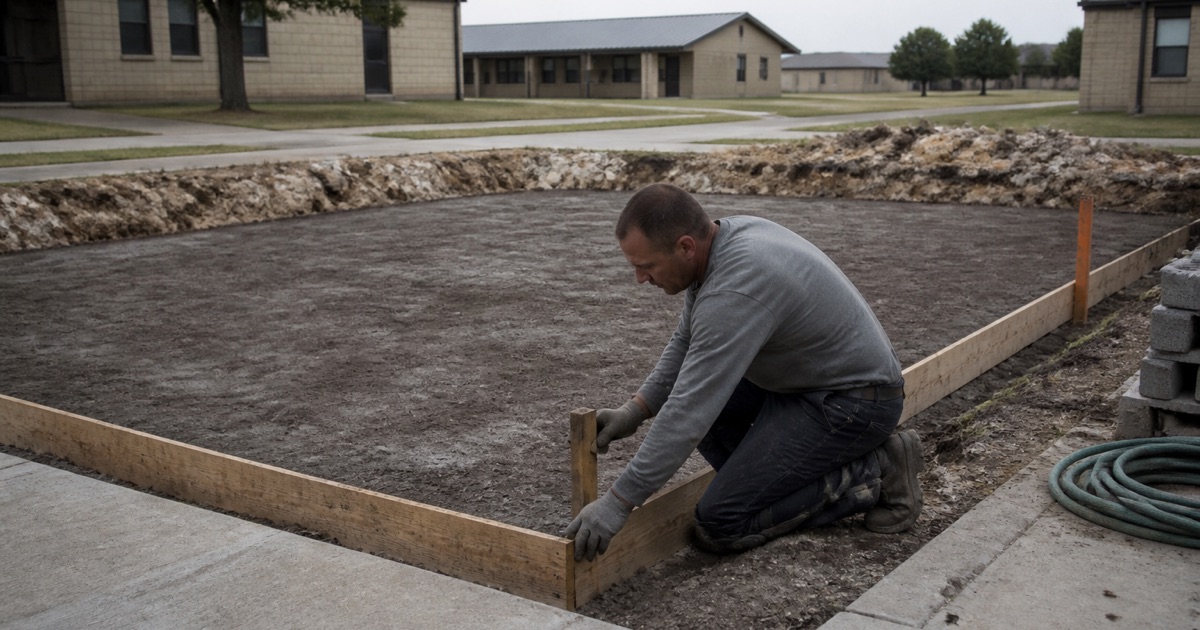
Any construction project on the installation that includes excavation or penetration of the ground surface must first obtain an approved FH Form 200-10, Land Excavation and Water Use, universally called the Dig Permit. It covers mechanical and hand digging alike, down to stake placements, grounding rods and sign posts.
It also binds soldiers, contractors and private individuals equally, so there is no category of person and no size of job that sits outside it. Setting a string line with wooden stakes is ground penetration. We build the permit into the program from the beginning rather than treating it as paperwork to catch up on.
What Has to Be in Place Before You Submit
The Dig Permit sits at the end of a queue rather than the start of one. A Storm Water Pollution Prevention Plan, air and waste permits, and any DA Form 4283 authorization all have to be obtained before the dig permit is submitted and before utility locates are even requested.
Fort Hood DPW, at Bldg. 4612 Engineer Drive, asks for three business days simply to acknowledge a submittal. Sequencing those approvals in the right order is the difference between a project that starts on the date you were given and one that spends its first two weeks in a queue nobody mentioned.
Two Separate Approval Paths on One Installation
Digging or staking in a training area or on a range does not go to DPW Environmental at all. It routes instead through Range Operations and Integrated Training Area Management, which is a second and entirely separate permit path running on the same post.
Which path a job takes is decided by where it sits rather than by what it is, so the same slab detail can follow two different approvals depending on the parcel. Establishing that at the outset avoids submitting to the wrong office and starting the clock over from zero.
The Ground: San Saba Clay Over Limestone
The Built Cantonment Sits on a Vertisol
The built cantonment is mapped as the San Saba-Urban land complex at 0 to 3 percent slopes, 54 percent San Saba and 25 percent urban land. San Saba is classified a fine, smectitic, thermic Leptic Udic Haplusterts, which puts an expansive Vertisol directly beneath the developed footprint.
That profile runs a plasticity index of 38 with 52.5 percent clay from the surface down to 91 centimeters, about 36 inches, where it terminates on indurated lithic bedrock. On the San Saba clay unit off the built area the same rock sits at 76 centimeters, roughly 30 inches.
Depth to Rock Changes Over a Few Hundred Feet
Purves silty clay and the Eckrant-Purves association both hit lithic bedrock at 36 centimeters, about 14 inches, and Brackett loam meets weakly coherent paralithic bedrock at 41 centimeters, roughly 16 inches. A footing trench that cut freely on one parcel meets limestone a few hundred feet away.
We establish depth to refusal before pricing rather than after breaking ground, because on a shallow-rock parcel the rock excavation is the job rather than a line item beneath it. Quoting as though the limestone is not there is how a number doubles halfway through a dig.
Brackett Loam Is the Local Exception
Brackett loam is the one common soil mapped here that does not tell the expansive story. It runs a plasticity index of 11 in the A horizon and 13 in the Bk, with only 21 to 25 percent clay, which puts it below the threshold every other major soil here clears comfortably.
IBC section 1803.5.3 treats a plasticity index of 15 or greater, determined by ASTM D4318, as the first of four provisions defining an expansive soil. San Saba at 38 to 40, Purves at 33 to 39, Eckrant at 37, Crawford at 33 to 37, Denton at 35 to 37 and Krum at 32 to 35 all clear it. Brackett does not.
Compacting Above Optimum, Not Below It
UFC 3-250-04, Standard Practice for Concrete Pavement Construction, dated 29 January 2024, requires at paragraph 4-2.2.2 that expansive subgrades be brought to a moisture content 1 to 3 percent above optimum before compaction in order to reduce swell potential.
That is the opposite direction from the 1 to 2 percent below optimum the same document specifies for non-swelling fine-grained soils. It is a genuinely counterintuitive requirement and it is exactly the sort of detail that separates a contractor who has worked on the installation from one who has not.
Housing, Barracks and Who Actually Signs
Cavalry Family Housing Owns the Family Stock
Essentially all family housing on the installation is owned by Cavalry Family Housing, headed by Centinel Public Partnerships of Nashville, with the Army as a silent partner that contributed the land and the initial housing stock. That has been the name since 1 May 2023.
It matters for concrete work because the owner and its design review, rather than the resident or the garrison, is who approves changes to a family housing property. Getting that wrong wastes a site visit and occasionally a whole scope of work that was never going to be authorized.
The Villages and What the Stock Is Made Of
The garrison Housing Services Office lists the villages as Chaffee, Comanche 1, Comanche 2, Comanche 3 East, Comanche 3 West, Kouma, Liberty, McNair, Montague, Patton Park, Pershing Park, Venable and Wainwright Heights, with community offices also covering Heritage Heights.
The stock behind those names is overwhelmingly attached: 4,388 of 6,634 total housing units, 66.1 percent, are single-family attached against 1,275 detached, 19.2 percent. Heritage Heights adds about 580 newly built single-family homes of roughly 1,700 square feet with three bedrooms and a two-car garage.
Barracks and Military Construction
Barracks are delivered through the U.S. Army Corps of Engineers rather than through anything resembling a residential contract. Barrack 101 opened on 19 May 2026 with 124 rooms housing 248 soldiers, authorized at 80 million dollars in fiscal year 2022 and delivered at 65.5 million by USACE with Cerris Builders.
Garrison commander Col. Mark McClellan has put the installation at 100 barracks with occupancy of about 10,500 soldiers against room for 12,000, and noted that since 2011 all but four have been built new or renovated. That is a continuous flatwork program rather than an occasional one.
Federal Contracting Is the Route In
Commercial work here is federal contracting rather than a homeowner sale, and the paperwork starts well before the concrete does. FAR 52.204-7 requires an offeror to hold an active SAM.gov registration both when submitting an offer and at time of award, with FAR 52.204-13 requiring it be maintained through final payment.
FAR 22.403-1 applies the Davis-Bacon Act to any contract over 2,000 dollars for construction, alteration or repair of public buildings or public works, carrying the FAR 52.222-6 prevailing wage clause with it. Both facts shape the price of on-post work before a single yard of concrete is ordered.
Access Controls the Schedule as Much as Weather
Operating conditions on the post can close a job that has nothing wrong with it. The senior commander closed the entire installation on 27 January 2026 for freezing temperatures and poor road conditions, closing the Warrior Way, Santa Fe, 79th Street and Mohawk gates.
Contract personnel were directed to contact their supervisors for reporting instructions rather than simply arriving. We plan on-post schedules with that in mind, because a crew and a loaded truck turned away at a gate is a wasted pour rather than a delayed one.
- 20+ Years in Central Texas
- Registered and Insured in Killeen
- Free Written Estimates