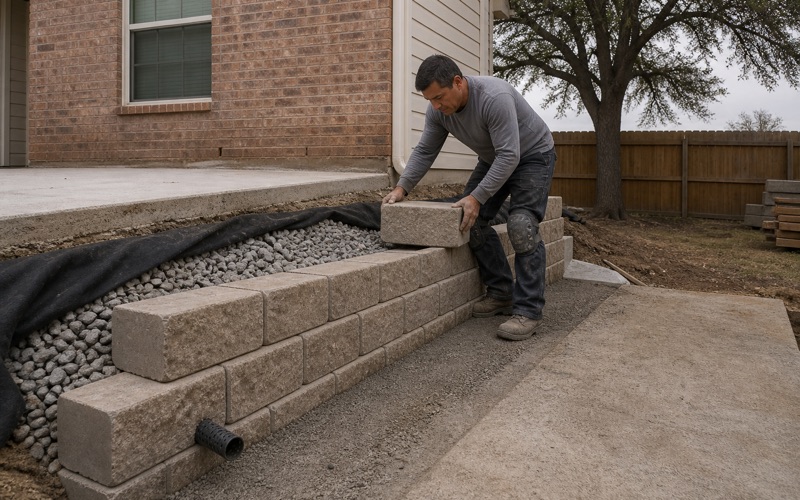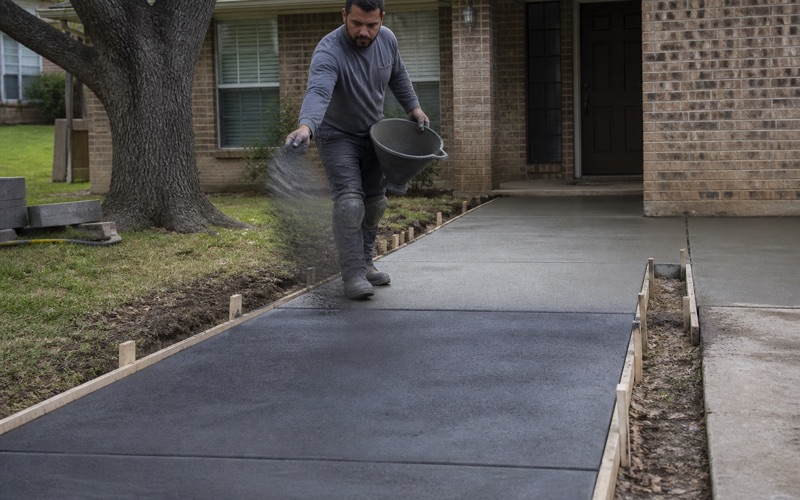
Killeen Elite Concrete works as a concrete contractor in Gatesville, TX, and the thing that decides the price of a dig here is a cemented layer most people do not know is under their yard. The Cho series carries a petrocalcic horizon rated strongly coherent with an upper depth of 28 centimeters, about 11 inches, and it does not care what the topsoil looks like.
That is the recurring surprise on this side of the county. A lot can read as a friendly fine sandy loam at the surface and stop an auger a foot down on caliche or on indurated limestone. Pidcoke reaches indurated lithic bedrock at 33 centimeters, Real paralithic bedrock at 36 to 38 and Doss at 46, so refusal is routinely inside the depth a footing wants.
This is the Lampasas Cut Plain rather than the prairie country east of here, and the soils under the built-up area reflect it. Reactive clay is present, but it covers only about 8.6 percent of the mapped area. What sets the cost of work here is breaking material rather than accommodating movement.
The Cemented Pan and the Rock Beneath It
A Petrocalcic Horizon About a Foot Down
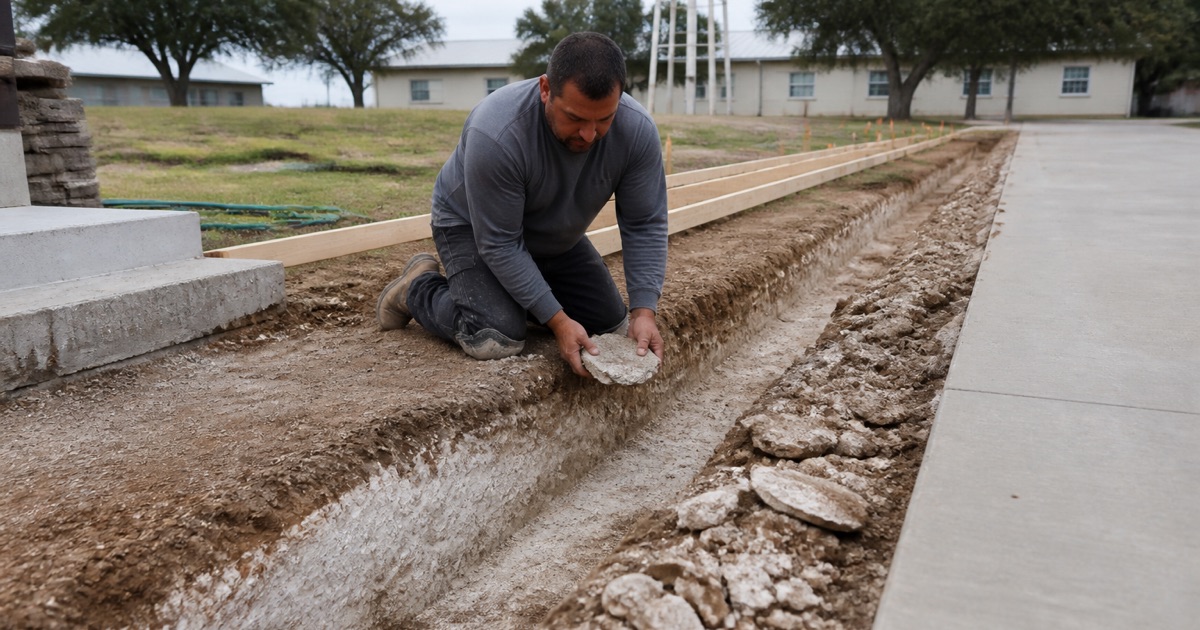
Cho clay loam is classified Loamy, carbonatic, thermic, shallow Petrocalcic Calciustolls, and its petrocalcic restriction is rated strongly coherent beginning at 28 centimeters. It covers roughly 5.6 percent of the mapped area over the built-up city, which understates how often it turns up on a job.
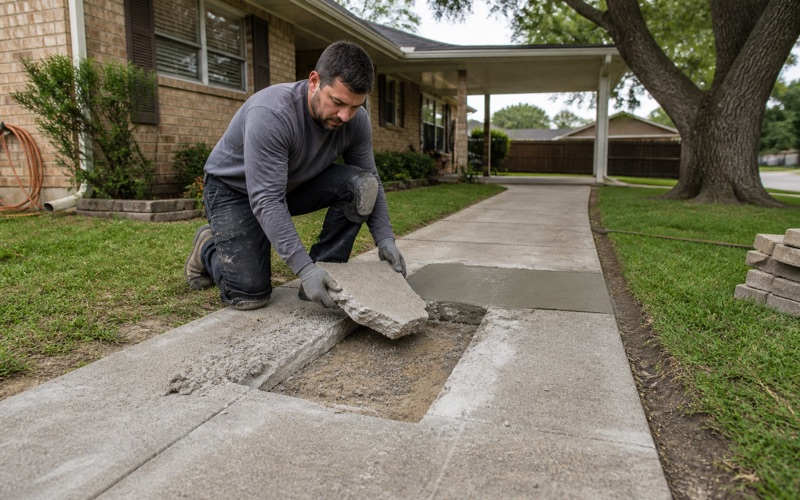
Strongly coherent is not a layer a machine works through by pushing harder. A footing trench, a post hole, a thickened edge or a utility run that meets it needs breaking, and that is an equipment and time decision rather than a line somebody can absorb. We establish it before quoting rather than discovering it on the morning.
Indurated Limestone Across Much of the Area
Pidcoke reaches indurated lithic bedrock at 33 centimeters and Real paralithic bedrock at 36 to 38, with Doss at 46 and Eckrant beginning its R horizon at 23 centimeters in the stony phase and 38 in the cobbly one. Topsey runs deeper, meeting densic bedrock at 81 centimeters.
The Topsey-Pidcoke association covers about 7.0 percent of the built-up area, the Real-Rock outcrop complex about 3.1 percent and Doss-Real about 2.5 percent. Coryell County’s largest-acreage soils are carbonatic Calciustolls over limestone, and the city sits squarely in that pattern.
What a Surface Reading Does Not Tell You
Minwells fine sandy loam is the single largest unit over the built-up area at 22.0 percent, and its A horizon down to 23 centimeters carries only 13 percent clay with a plasticity index of 8. That reads as unremarkable ground and it is, for the first nine inches.
The Bt1 horizon from 23 to 51 centimeters is a different material entirely: 42 percent clay with a plasticity index of 30, comfortably past the plasticity index of 15 that IRC section R403.1.8.1 uses as one of its criteria for an expansive soil. Reading a profile matters more here than reading a yard.
Looking for concrete contractor closer to Serenada? See Serenada Concrete Contractor.
The Movement That Does Exist, and Where
Slidell Is the Reactive Unit
Slidell silty clay is a Fine, smectitic, thermic Udic Haplusterts running 45 to 50 percent clay with a plasticity index of 40 in both the Ap and Bss horizons and linear extensibility of 8.6 to 9.7 percent. It is genuinely reactive ground and it covers about 8.6 percent of the mapped area.
That share matters. On roughly one lot in twelve the detailing has to answer seasonal movement, and on the rest it has to answer rock. Building every slab in this city as though the ground swells is as wrong as building none of them that way.
Nuff and the Stony Surface Phases
Nuff very stony silty clay loam is the second largest unit at 18.6 percent, carrying 34 to 46 percent clay but a plasticity index of only 19 to 23 and linear extensibility of 3.5 to 6.9 percent. It is a low shrink-swell soil with a stony surface phase, which is its own excavation problem.
Bosque clay loam in its occasionally flooded phase covers about 15.1 percent of the built-up area along the Leon River side, and Frio silty clay is mapped in the same flooded phase. Flatwork down there sits on alluvium that saturates, which changes both the base and the drainage plan.
Permits Here, Without a Registration Requirement
No Municipal Contractor Registration Exists
This is unusual for the area and worth stating plainly: no general contractor registration appears anywhere in chapter 10 or chapter 46 of the city code. The building chapter’s only trade-licensing requirement is state electrical licensing under Texas Occupations Code chapter 1305, at section 10-54.
Combined with the fact that Texas issues no state license for concrete work at all, that means there is no local credential to check here. What you can check instead is insurance, references and whether a contractor knows the ordinances below. We would encourage all three.
The Permits That Do Apply
Section 46-6 requires a city permit to build, remove, repair, vary the grade line, change or alter any sidewalk, curb or gutter along the line of any street or alley, and section 46-3 requires an excavation permit before any opening or cut in a street, alley or other public property.
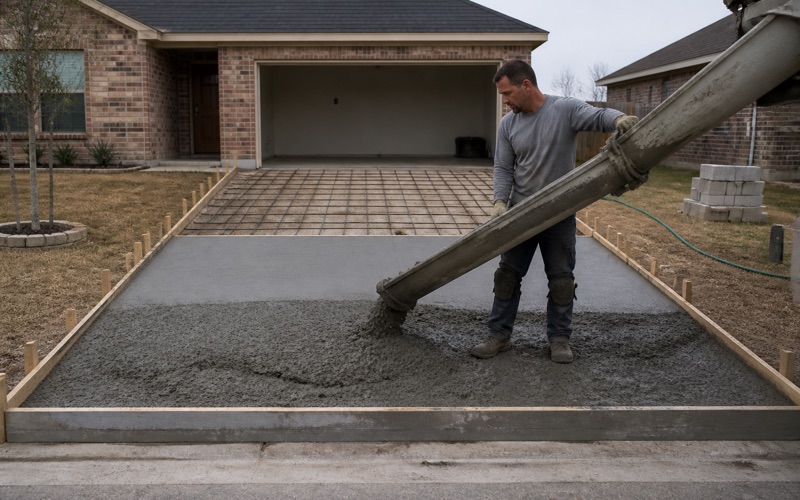
The city’s own guidance for concrete, flatwork, driveways and approaches asks for a color site map with the flatwork marked, dimensions to buildings and to each property line, connection details to existing concrete, and the concrete strength, steel size and slab dimensions at 12 inches on center. All approaches require approval from Public Works.
The Rules Around Starting
Contractors must allow 24 hours after a permit is issued before starting work, which is a scheduling detail worth building into a program rather than discovering. Inspection requests submitted before 4:00 p.m. are scheduled for the next business day, and same-day inspections are handled on an emergency basis only.
Homeowners may pull permits on property they own and hold a homestead exemption on. Commercial new construction or remodel over 49,999 dollars must be registered with the Texas Department of Licensing and Regulation before a permit can be issued, which is the accessibility threshold arriving through the city’s own counter.
Cutting a Street, and the Year That Follows
A Repair Bond Before the Cut
Section 46-87(b) requires a bond in the estimated cost of repair and maintenance before cutting any street, driveway, sidewalk or city right-of-way, with franchised utilities permitted to post a single standing bond of at least 5,000 dollars instead. That is a real barrier to a contractor who has not planned for it.
We treat it as part of scoping any job that touches the right of way, because the bond has to be in place before the cut rather than arranged afterward. A crew arriving to find they cannot legally open the street is a wasted day for everybody.
Twelve Months of Liability
Section 46-90(a) puts 12 months of maintenance and repair cost on the contractor from the date of the original cut. Section 46-95 then requires repair within ten days of notice where a cut settles as little as 1 inch within those 12 months, on pain of bond forfeiture.
An inch of settlement in a year is a tight tolerance, and it is entirely a function of how the backfill was placed. That is why the compaction rules below are not paperwork: they are the difference between a bond released and a bond called.
How the Patch Has to Be Built
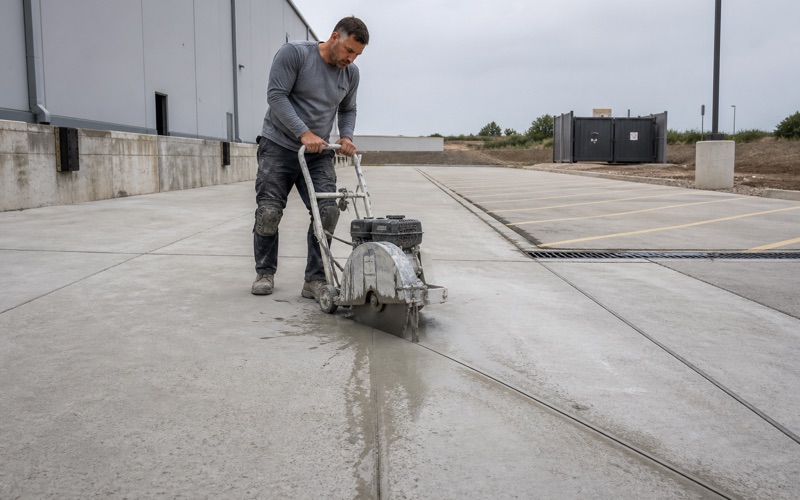
Section 46-98 requires two parallel saw cuts 12 inches wider than the ditch width, a saw cut depth of not less than 2 inches, concrete replaced with concrete, expansion joints at cold joints, and a patch surface flush and uniform with the adjoining area.
Section 46-92 caps backfill lifts at 6 inches and section 46-93 requires at least 8 inches of compacted base after compaction. Those two clauses are what the twelve-month settlement rule is really testing, and they are the first thing a hurried crew abandons.
Outside the City, and Onto the Highway
The County Driveway Permit
Coryell County requires a driveway permit for any access from a county-maintained roadway onto private property, with sufficient right-of-way for a culvert. Driveways must be a minimum of 200 feet apart, and lots must have 60 feet of frontage onto an existing county-maintained roadway.
Those spacing and frontage rules catch people subdividing rural acreage, because they can rule out an access point that looks obvious on a plan. Establishing them before a driveway is designed is considerably cheaper than relocating one afterward.
The County’s Concrete Edge Beam
Coryell County street design standards specify a concrete edge beam of 12 inches by 8 inches built with two 3/8 inch bars and half inch by 24 inch smooth dowels at construction joints spaced no more than 40 feet apart. All curb and gutter and edge beam is constructed over a minimum of 6 inches of compacted base extending 1 foot back of the curb or beam.
That is a published detail rather than a preference, and it is a different standard from what the city applies inside its limits. Knowing which one governs a given address is the first question on any job at the edge of town.
Where the State Standard Takes Over
Section 46-10 is short and consequential: the regulations established by the state department of transportation shall govern in the design, construction and maintenance of access driveways on city streets of highway routes within the city. US Route 84 runs through the city and State Highway 36 passes through the eastern side.
That means a driveway onto Main Street through downtown is built to a state standard rather than a municipal one, administered through the Waco district. It is an easy thing to get wrong on an address that feels entirely local.
The Institutional Base This City Runs On
State Units as Property and Employment
The Texas Department of Criminal Justice operates six units at Gatesville. Crain, Hilltop, Murray and Woodman are co-located on approximately 1,283 acres, Hughes occupies approximately 390 acres and O’Daniel approximately 97, and together the six carry 2,405 employees against a design capacity of 7,785.
Hilltop houses the Region VI regional maintenance headquarters, regional medical offices and a training facility, with garment factories at Hilltop and Hughes and a Braille facility at O’Daniel. Work on state-owned grounds is bought through state processes rather than over a counter, which is a different route entirely.
Accessibility Review and the Downtown District
The Texas Architectural Barriers Act registration threshold is a total estimated project cost of 50,000 dollars under Government Code chapter 469, and public right-of-way projects such as sidewalks and curb ramps are within scope. Projects below the threshold still have to comply with the accessibility standards.
Under 16 Texas Administrative Code section 68.52 the owner must request a registered accessibility specialist inspection no later than 30 calendar days after completion and obtain it within a year. Downtown, the Gatesville Downtown Historic District was listed on the National Register on 6 February 2026, covering 12 blocks and 87 resources around the 1897 courthouse.
- 20+ Years in Central Texas
- Registered and Insured in Killeen
- Free Written Estimates