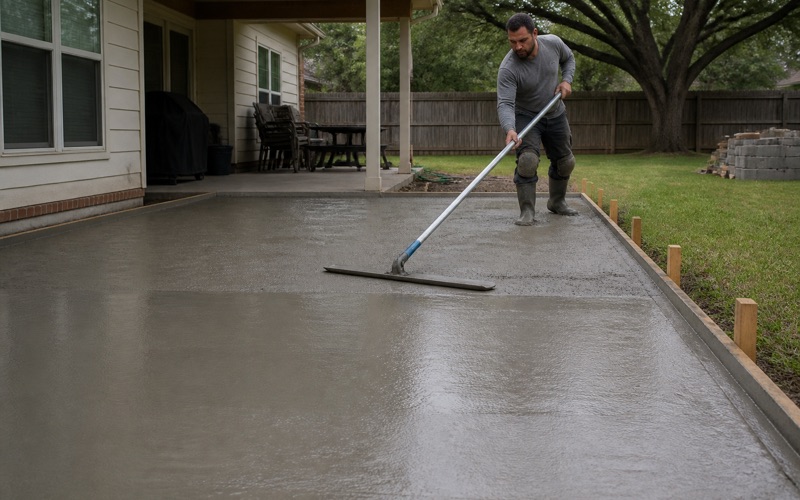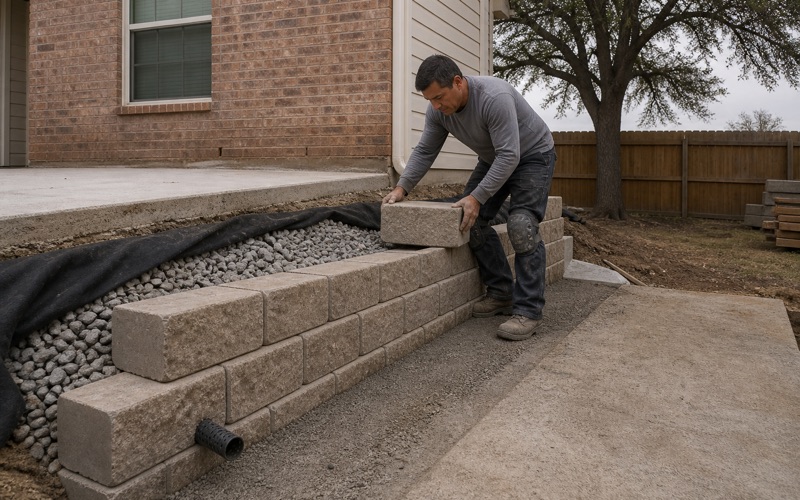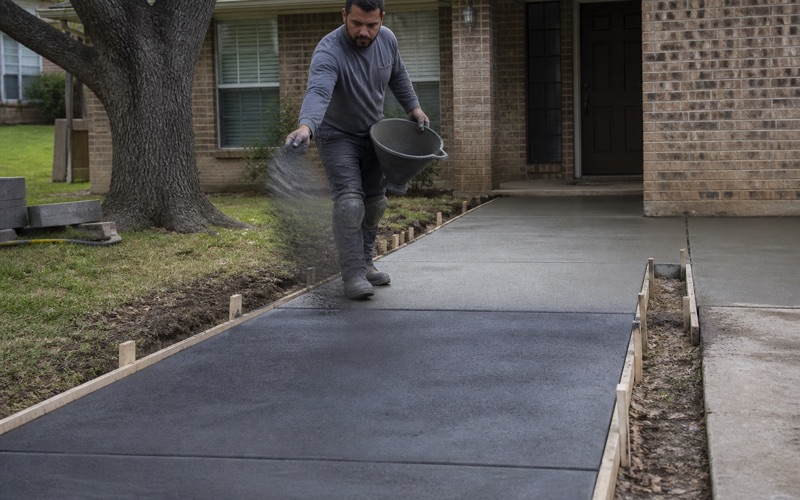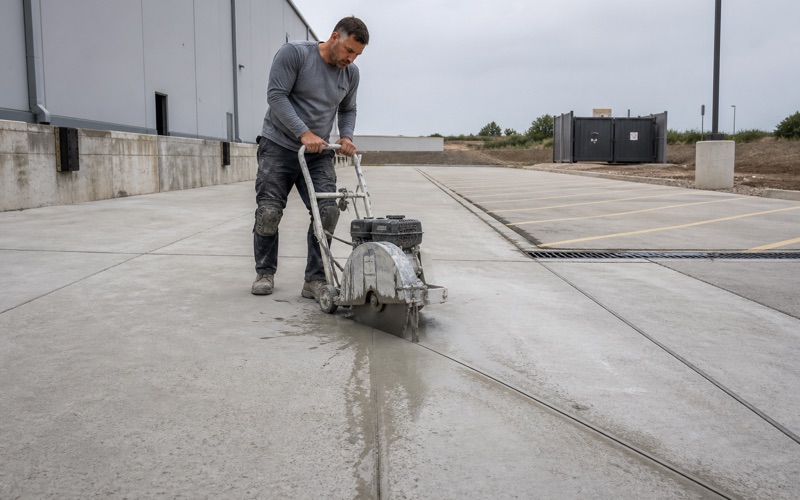
Killeen Elite Concrete works as a concrete contractor in McGregor, TX, under the most prescriptive residential concrete ordinance in this part of Central Texas. Section 50-114 does not simply require a strength and leave the rest to judgment: it names the mix, the depth, the base, the mesh size, the dowel and the finish, in dimensions a city inspector can measure with a tape.
It also puts real teeth behind the inspection. Section 50-111 requires a pre-pour inspection, gives the department up to two working days to send an inspector, and makes it a misdemeanor to pour driveway concrete without the inspector’s approval displayed on the posted permit. That is a criminal offense attached to a scheduling shortcut.
We like working here for exactly that reason. When the specification is written down to the mesh, there is no argument about what a proper job looks like, and a contractor who builds to it is not competing against one who quietly does not. The variable that is left is the ground, and in this city that varies more than most.
An Ordinance That Specifies the Steel
The Mix, the Depth and the Base
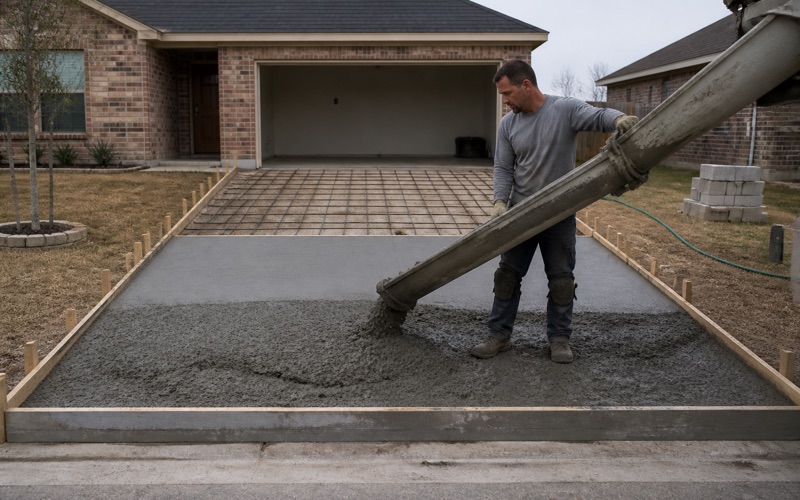
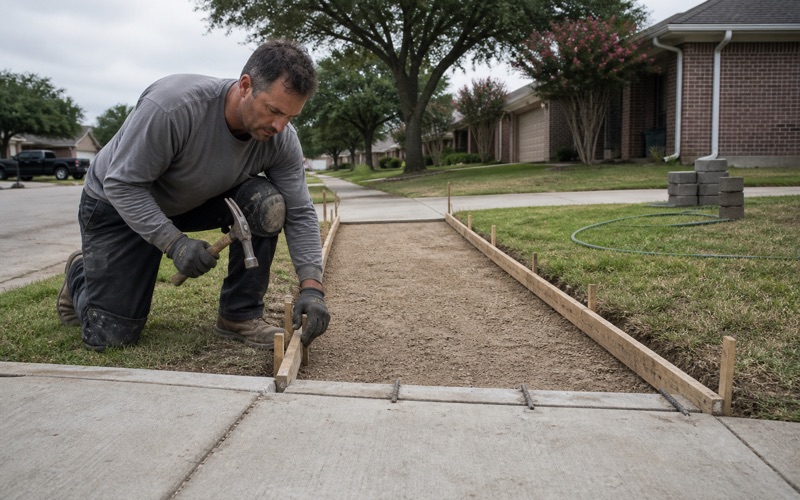
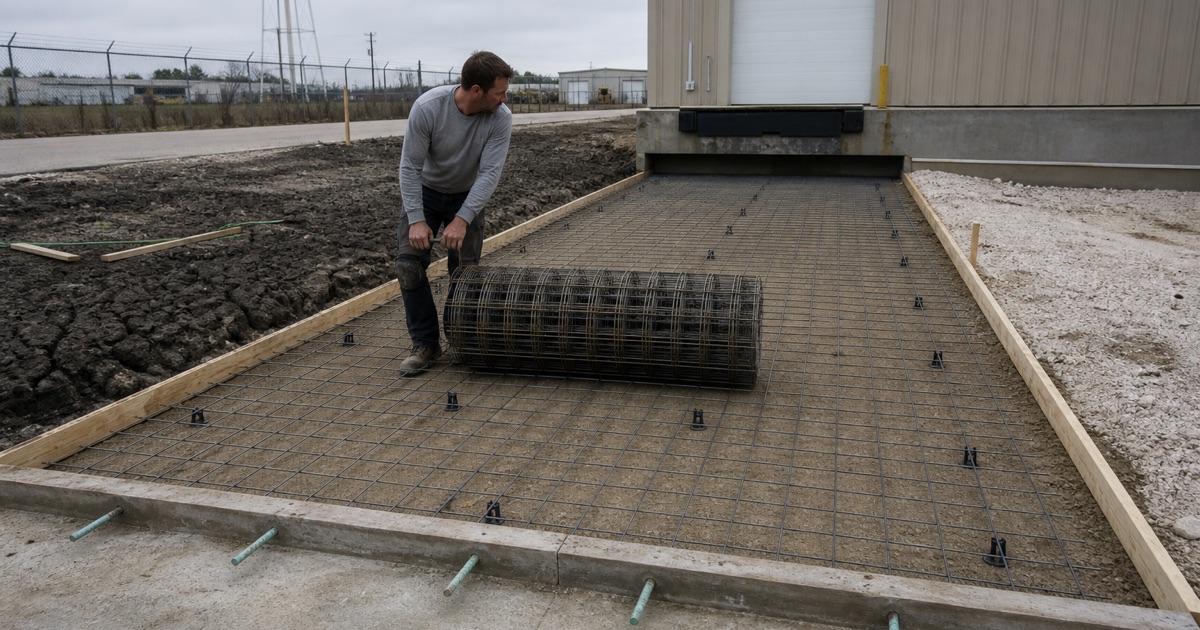
Driveway and sidewalk concrete must be class A at 3,000 psi compressive strength at 28 days, at least 4 inches deep over a sand, rock or crushed screening base at least 2 inches deep. Drive approach concrete must be the same class A mix at 3,000 psi, at least 6 inches deep over a base at least 4 inches deep.
The doubling of the section at the approach is the part people miss when comparing quotes. An approach is not a driveway that happens to be nearer the street, and pricing it as though it were is the most common way a cheap number gets to be cheap here.
Mesh and Dowels Are Named
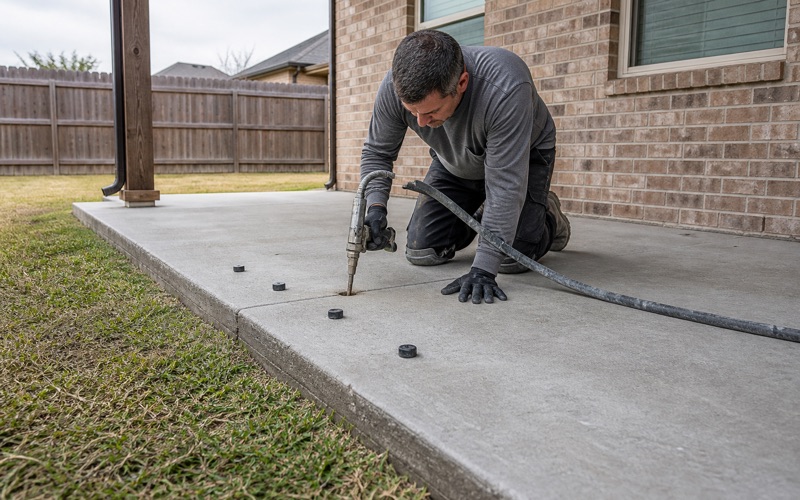
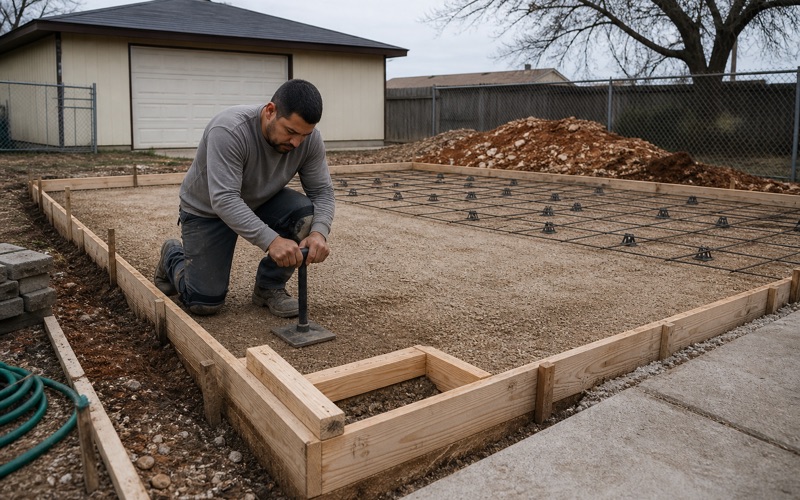
Number 9 wire mesh at 10 inches on center may substitute for three-eighths inch bars in sidewalk, and number 6 wire mesh at 10 inches on center in driveway and drive approach. Dowels are half inch smooth steel, 24 inches long, coated to allow free movement.
The count is specified too: a minimum of four dowels for a single driveway and six for a double. Expansion joints of asphaltic joint material, redwood or cedar go between the drive approach and the driveway and on each side of the existing curb, so the assembly is defined end to end.
Geometry and Finish
A single driveway is not less than 10 feet and not more than 12 feet wide, and a double not less than 16 and not more than 24. The minimum drive approach radius is two and one-half feet, approach slope may not exceed a one foot to five foot ratio, and no drive approach may sit closer than 15 feet to any radius point of a street intersection.
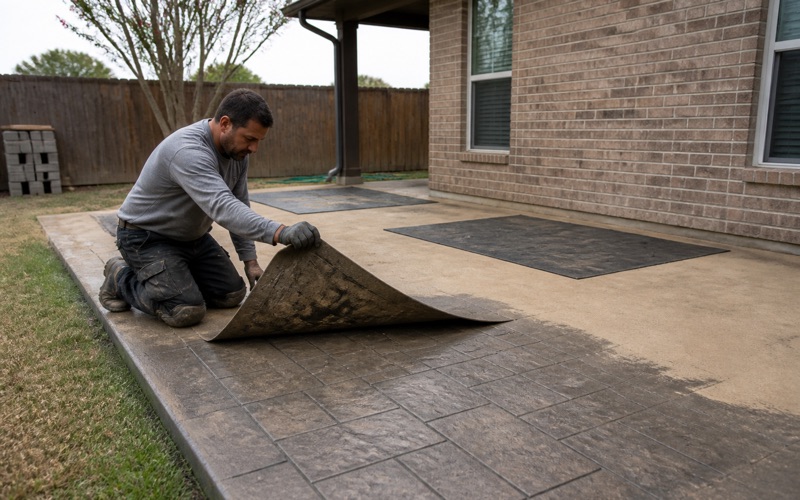
Exposed corners are tooled to a one quarter inch radius and the finish is broom or washed. Anyone wanting a decorative finish on a driveway in this city needs to understand that the ordinance has already answered the question for the portion in the right of way.
Looking for concrete contractor closer to Fort Hood? See Concrete Contractor in Fort Hood.
The Inspection You Cannot Legally Pour Without
Permit First, With a Clock
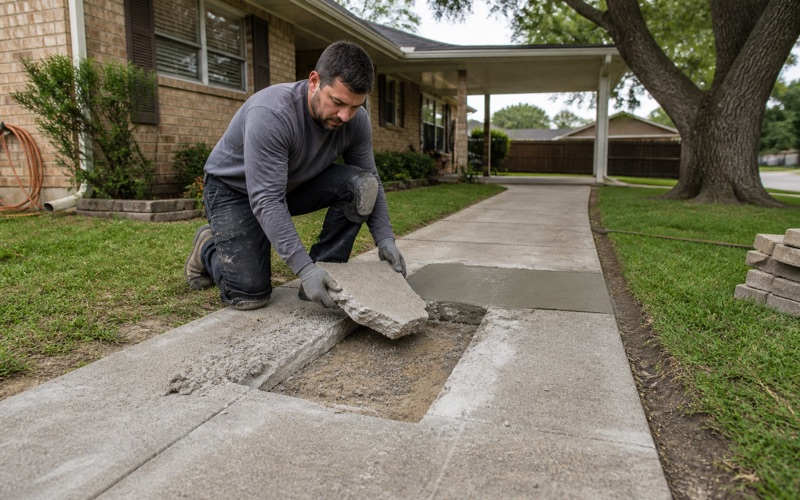
Section 50-108 requires a contractor to obtain a driveway permit from the inspection department before beginning work, and that permit expires 180 days after issuance if work has not started. It is a separate permit from the building permit and it runs on its own timeline.
Section 50-110 requires a bond filed with the city manager before a contractor engages in driveway construction at all. Between the permit, the bond and the registration below, there is a real barrier to a crew that turns up without having worked here before.
Two Working Days for the Inspector
The pre-pour inspection has a defined window: the department has up to two working days to send an inspector once it is requested. That is a scheduling fact rather than a courtesy, and it has to sit inside the program rather than beside it.
Pouring without that approval displayed on the posted permit is a misdemeanor under section 50-111. We would not take that risk on any job, and a contractor who offers to is telling you something useful about how they handle the parts you cannot see.
A Year of Liability Afterward
Section 50-112 requires the contractor to keep the driveway free from defects for one year from the date of the permit. That period is long enough for a poorly compacted base to show itself, which is precisely the point of it.
Combined with the prescriptive specification, it means the incentives here point the same way ours do. There is no advantage to be had from a thin base or light steel when the inspector measures it going in and the contractor owns it for twelve months afterward.
Registration, Renewed Every Year
Section 12-223 requires any person performing or contracting to perform a construction operation within the city limits to hold a valid building contractor registration certificate, renewed on or before the first day of January each year. The permit application form carries a registration status box.
Concrete is not one of the eight enumerated registration types in section 12-224(d), so under section 12-224(e) a flatwork contractor registers as a general contractor. Since Texas issues no state license for concrete work, that municipal registration is the credential to ask about.
Deep Clay and Shallow Rock in the Same City
Three Soils Cover Most of It
Clipping the soil survey polygons to the city boundary puts Crawford silty clay at roughly 36 percent of the mapped city area, Slidell silty clay at roughly 28 percent and Purves clay at roughly 19 percent, with Aledo gravelly clay loam, Purves gravelly silty clay and Bolar gravelly clay loam accounting for most of the remainder.
The clays here move enough to lift a slab. Slidell carries a plasticity index of 40 through the upper 89 centimeters, Crawford runs 33 at the surface and 37 in the Bss horizons at 10 to 12 percent linear extensibility, and Sanger runs 32 to 34, all far above the plasticity index of 15 the 2015 International Residential Code names at R403.1.8.1.
A Quarter of the City Hits Rock Inside Twenty Inches
About a quarter of the mapped city area sits on soil reaching hard limestone within 20 inches. Aledo hits lithic bedrock at 30 centimeters, about 12 inches, and Purves at 36 centimeters, about 14 inches, while Crawford reaches rock at 71 centimeters and Bolar at 97.
Slidell and Frio have no bedrock restriction within 200 centimeters at all. Two jobs a few streets apart can therefore be a deep expansive clay excavation and a shallow rock cut, and those are different machines, different durations and different prices.
The Surface Can Read the Wrong Way
Aledo and Purves surface horizons are gravelly and carbonatic rather than plastic, with Aledo’s A horizon at a plasticity index of 16 and its Bk horizon at 11. Ground that feels firm and workable in the first spade is sitting directly on limestone a foot below.
That is why we establish depth to refusal and the soil unit before quoting rather than after. It changes the excavation line, not the concrete line, and it is the single largest source of variation between two apparently similar driveways in this city.
Runoff, Permits and the Reach Past the City Limits
A Permit Where None Would Otherwise Apply
Section 12-193 catches flatwork nothing else would reach. If construction abuts a city street, alley or other public way, or alters the flow of surface runoff water, a building permit is required even where none would otherwise be, and that requirement applies inside the city limits and inside the extraterritorial area.
The permit is refused if the work would divert runoff into public streets or damage other property. Section 50-177 separately makes it unlawful to change the natural flow of stormwater onto a street, alley or a neighbor’s property except under the city engineer’s supervision on a council-approved plan.
The Standards a Job Is Built To
All streets, driveway entrances and sidewalks built inside the city limits or in the extraterritorial area must conform to state highway department standards under section 50-61, and all work under the streets and sidewalks chapter follows the North Central Texas Council of Governments Standard Specifications for Public Works Construction under section 50-62.
Nonresidential driveways follow the state’s Regulations for Access Driveways to State Highways. Because US 84 runs through the city center and State Highway 317 crosses near it, approach work on those frontages falls to the TxDOT Waco District rather than to the city, since section 50-107 excepts state-controlled roads from the city’s driveway division.
Small Slabs Are Not Exempt Here
The city adopted the 2015 International Codes and deleted two standard permit exemptions, so one-story detached accessory structures of 120 square feet or less and fences not over 6 feet high both require a permit. That pulls small shed slabs and post footings into the permit system where most cities leave them out.
Before any inspection of new commercial or residential construction, section 12-214 requires a covered trash receptacle no smaller than 24 square feet by four feet high with openings no larger than 9 inches, a project address posted in numbers not smaller than 6 inches, and worker toilet facilities within 100 feet of travel.
Commercial and Industrial Site Work
Gravel Does Not Count as Parking
For commercial paving, the zoning ordinance defines a paved area as asphalt, concrete, pavers or similar impervious surface and expressly excludes gravel. A parking space is defined as at least 200 square feet connected to a public street or alley by an impervious surface.
That combination means a gravel lot does not satisfy the parking requirement, however well it is maintained. On a commercial or light industrial site it is usually cheaper to build the surface properly once than to build it twice.
Street Work Carries a Heavier Bond
Section 50-85 requires a substantially larger bond from anyone constructing, repairing or improving city streets or public ways than driveway work carries, waivable at the city’s discretion against a general liability policy naming the city as an additional insured. Section 50-88 adds a permit from the city engineer, a completion date and a daily fine for work not completed on time.
Those provisions change how a commercial program has to be sequenced, because a missed completion date is billed rather than absorbed. We scope street-facing work against the calendar the permit sets rather than the one that suits the crew.
Two Counties, and Summer Heat
The city limits straddle a county line: downtown sits in McLennan County and the western end of the city limits in Coryell County, and the city is counted in both the Waco and the Killeen-Temple metro areas. Unincorporated work outside the limits falls to the counties, with on-site sewage facility permits issued by the Waco-McLennan County Public Health District.
Late-summer placement here is a genuine hot-weather concreting problem. The forecast generated for the McGregor grid point on 20 August 2026 carried daytime highs of 103 to 104 degrees with south-southwest winds through the following four days, which is a forecast value rather than a long-run figure, and it is the kind of week a pour gets scheduled against rather than through.
- 20+ Years in Central Texas
- Registered and Insured in Killeen
- Free Written Estimates