
Killeen Elite Concrete installs stamped concrete in Killeen, TX and the surrounding cities including Fort Hood, Harker Heights, Nolanville, Copperas Cove and Belton, with more than 20 years of decorative and structural flatwork behind it. Stamped concrete is the finish people ask for when they want the look of stone, brick or plank without the joint lines, the weeds and the individual units shifting over ground that moves the way this ground does.
It is worth being clear about what stamping actually is. The slab underneath is a normal structural pour with the same subgrade preparation, reinforcement and joint layout any slab needs here. The pattern, the color and the texture are applied to the surface while the concrete is still plastic, which means everything that decides whether a plain slab lasts still applies, and a decorative finish over a badly built slab simply produces an attractive crack.
Where a stamped job goes wrong is almost never the stamping. It is a pattern chosen at the wrong scale, a color picked from a chart indoors rather than against the house, or a joint plan that was ignored so the design could run uninterrupted. We settle pattern, color and joint layout together before the pour, because after the truck arrives none of those three can be revisited.
Choosing a Pattern That Suits the Property
Reading the House Before the Catalog
We start at the elevation rather than the sample board: the brick or stone already on the house, the roof color, the trim, and how large the area is relative to what surrounds it. A pattern that photographs beautifully in a supplier’s gallery can read wrong at your back door because the scale is off. Choosing against the building is what makes the finished slab look original to the house.
Ashlar Slate, Cobble, Tile and Wood Plank
An ashlar slate stamp pattern is the workhorse: irregular rectangular stone that reads formal, hides traffic and suits most elevations. Cobble and running bond patterns suit paths, courtyards and smaller footprints. Tile patterns suit covered areas that function as outdoor rooms, and wood plank suits a patio meant to feel like a deck without any of the maintenance a deck brings.
Seamless Texture Skins
A seamless texture skin lays a fine stone, slate or leathered texture across the slab with no repeating grid at all, and it is what most people around here settle on once they have seen the two side by side. It forgives a large irregular shape far better than a repeating pattern does, and paired with a sawcut border it reads like a tiled terrace without the joints.
Color, and How It Is Actually Built Up
Integral Color Through the Slab
Integral color is added to the mix at the plant so the pigment runs through the whole section. A chipped edge shows the same color as the surface, which is its real advantage over anything applied on top. On its own it produces a uniform, slightly flat tone, so it usually works as the base layer rather than the whole story.
Dry Shake Color Hardener and Antiquing Release
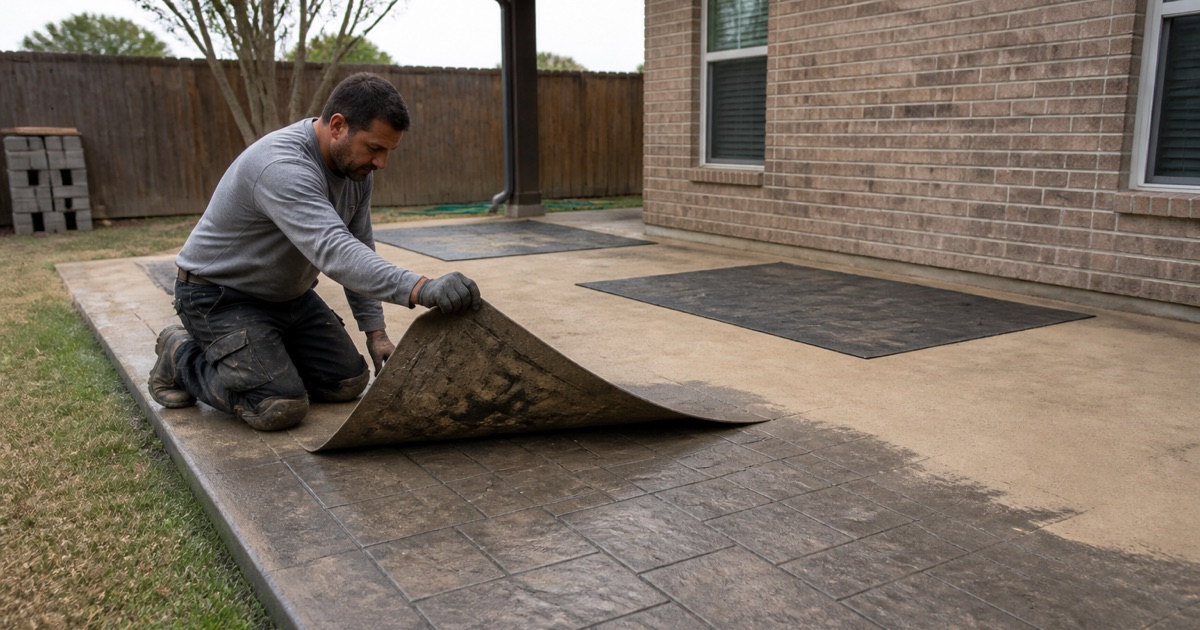
A dry shake color hardener is broadcast onto the plastic surface and worked in, adding both color and a denser, harder wearing top layer. Antiquing release powder goes on before the mats and lodges in the low points of the texture, which is what gives stamped work its depth and variation. Together they are the difference between a stone pattern and something that reads as a printed slab.
Deciding the Palette on Site
We put sample panels down and look at them outdoors, at the time of day the patio will actually be used, against the brick. Color reads differently in shade, under a covered porch and in full sun, and it reads differently again once sealed, which darkens it noticeably. Choosing from a photograph on a screen is the single most common source of regret on decorative work.
Building the Slab Underneath
The Same Ground Rules as Any Slab
The subgrade gets read, excavated, based and compacted exactly as it would for a plain pour, because expansive clay with a plasticity index in the high thirties over shallow limestone does not care what texture is on top. Where the rock sits nine to thirty inches down decides the excavation, and reinforcement is sized and chaired the same way. Decorative work is structural work with a finish.
Joints Designed Into the Pattern
Control joints still have to land at published spacing of roughly 24 to 36 times the slab thickness, so on decorative work we design them into the layout rather than cutting across a finished pattern afterward. Sawcut borders, bands and pattern breaks can carry the joint where it needs to be. Ignoring joint spacing to keep a design unbroken is how a stamped patio cracks through the middle.
The Pour Itself Has a Clock
Stamping has to happen inside a window while the concrete is still plastic enough to take the mats and firm enough to hold them, and above 90 degrees the truck already has only 45 minutes from batch to placement. Summer stamped pours are scheduled early and crewed to match, because a slab that stiffens before the mats are down cannot be recovered.
Living With Stamped Concrete
Sealing, and How Often
Sealing holds the color and the depth that the release and hardener created, and it is not optional on decorative work. A film-forming sealer gives gloss and richer color but has to be stripped and redone sooner; a penetrating sealer changes the look less and lasts longer. On slabs that sit in full sun through a Central Texas summer we usually lean penetrating, with a grit additive wherever slip matters.
Cleaning and Everyday Wear
Stamped work cleans with water and a mild detergent, and the texture that gives it grip also hides the ordinary marks a patio collects. What shortens its life is aggressive pressure washing that strips sealer, and de-icing chemicals, which have no business on decorative concrete. Furniture with hard feet and a dragged habit will mark a sealed surface, so pads are worth the trouble.
Repairing and Recoloring Existing Stamped Work
Faded or tired stamped concrete usually needs resealing rather than replacing, and stained or patchy areas can often be recolored. Where a slab is sound but plain, acid stain or a microtopping overlay can put a decorative surface onto it without a tear-out. Where the slab has cracked from a base problem, we fix that cause first; recoloring over a live crack wastes the work.
Our Step-by-Step Stamped Concrete Process
Design Meeting on Site
Pattern, color, border, joint layout and the footprint are all agreed standing on the ground where the slab will go, against the house rather than against a screen. Settling all five in one visit is deliberate, because each of them constrains the others and deciding them separately is how a design quietly stops working.
Sample Panel and Written Scope
We put down a sample panel so you see the pattern and the color combination outdoors in real light, and the written quote names the exact mat, the integral color, the hardener and the release. Naming them matters later, because a future repair or reseal can then match rather than approximate.
Subgrade, Base and Reinforcement
The area is excavated to the real depth to rock, based and compacted, and reinforcement is set on chairs with the joint plan already marked out on the forms. Marking joints before the pour rather than after it is what lets the borders and bands do double duty as control joints.
Pour, Stamp and Detail
The concrete goes in inside its discharge window, gets colored, released and stamped, and the borders and bands are sawcut early with a dry cut saw. Stamping is crewed heavily for exactly this reason, since the gap between concrete too wet to hold a mat and concrete too stiff to take one is short in summer.
Wash, Seal and Hand Over
Release is washed off, the slab is sealed once it has properly cured, and we walk it with you and tell you when it takes furniture and everyday traffic. We also leave you a written record of what went onto the slab, so a future reseal matches instead of guessing.
- 20+ Years in Central Texas
- Registered and Insured in Killeen
- Free Written Estimates